Zinc and qualified barrier stacks protect suitable substrates when thickness, supplementary finish, geometry, and exposure are correctly specified.

Metal deposits engineered for function and finish
Electroplating
Controlled metallic coatings for corrosion protection, conductivity, solderability, wear, dimensional build-up, reflectivity, or appearance—matched to the substrate and service requirement.
Project guide
How should a plated layer be specified?
Specify the deposited metal or layer system for the required function. Appearance, dimensional allowance, adhesion and post-treatment may all affect the accepted result.
How electroplating works
Electrical Current Builds a Metallic Layer on the Part
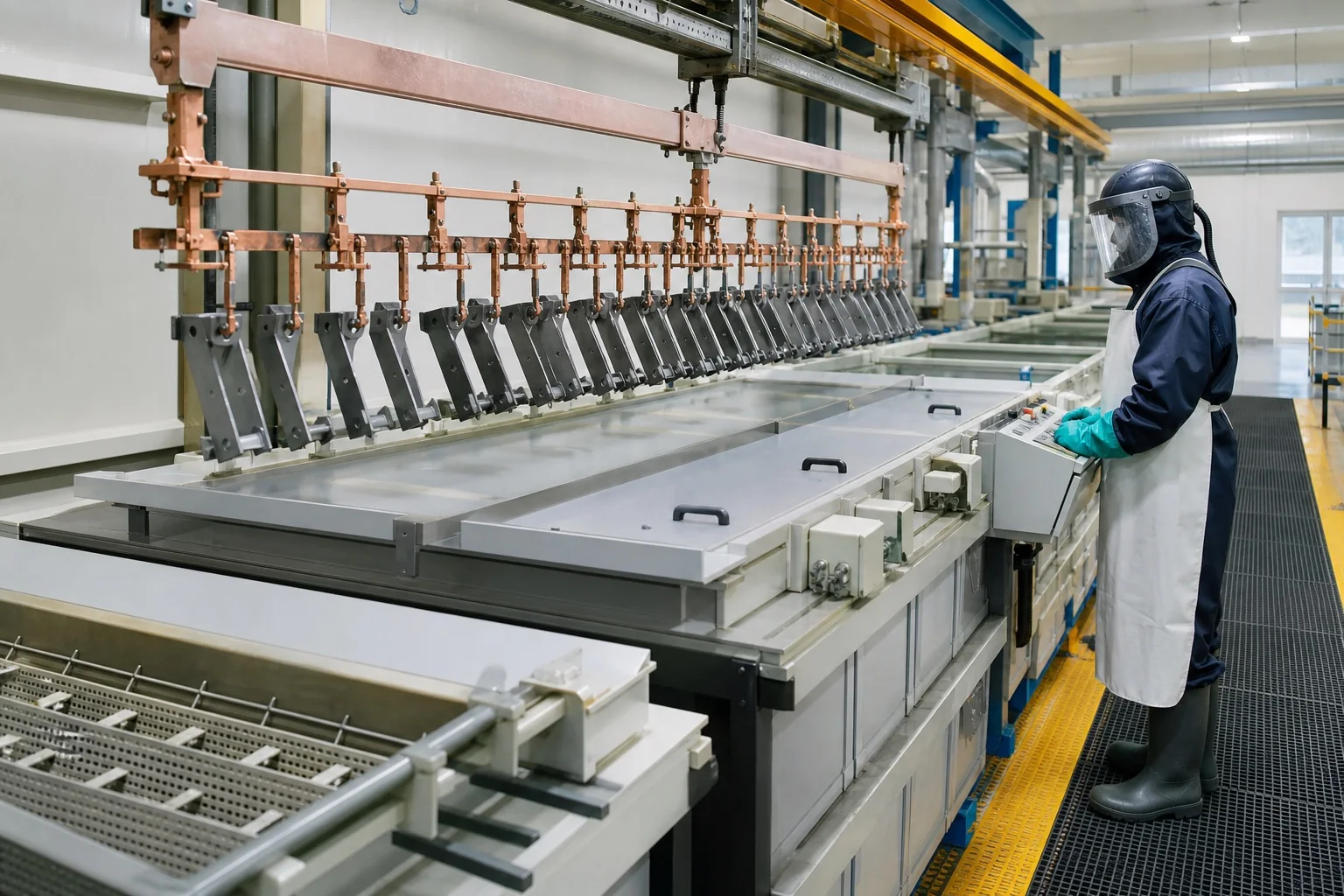
After cleaning and activation, the conductive workpiece is connected as the cathode in an electrolyte containing metal ions. Direct current reduces those ions onto the surface while soluble or inert anodes and solution control maintain the process.
Adhesion begins with the substrate, not the plating tank. Alloy, heat treatment, oxide condition, polishing compound, scale, geometry, rack contact, current density, agitation, bath chemistry, rinsing, and post-treatment all influence the finished deposit.
Copper, nickel, tin, silver, and gold systems support conductivity, contact stability, solderability, or wire-bonding requirements.
Engineering nickel or chromium can add hardness, wear resistance, or controlled dimensional restoration to selected surfaces.
Bright, satin, matte, dark, and decorative multilayer finishes can be developed using the correct preparation and plating stack.
Deposit selection
Choose the Metal for the Required Property
The visible top layer may depend on one or more underplates. Substrate compatibility, porosity, diffusion, galvanic behavior, service temperature, and regulatory restrictions must be reviewed as a complete stack.
Zinc & Zinc Alloy
Sacrificial corrosion protection for iron and steel, normally paired with a specified passivate or sealer. Appearance and corrosion performance depend on the exact system.
Nickel & Copper
Nickel supports barrier protection, wear, build-up, and underplate functions; copper offers conductivity, ductility, leveling, and an intermediate layer for selected stacks.
Tin, Silver & Gold
Used for solderable surfaces and electrical contacts where conductivity, contact resistance, mating cycles, diffusion control, and storage environment are defined.
Chromium
Decorative chromium is typically a thin top layer over a prepared nickel system, while engineering chromium is a different functional process for hardness and wear.
Plating stack and appearance
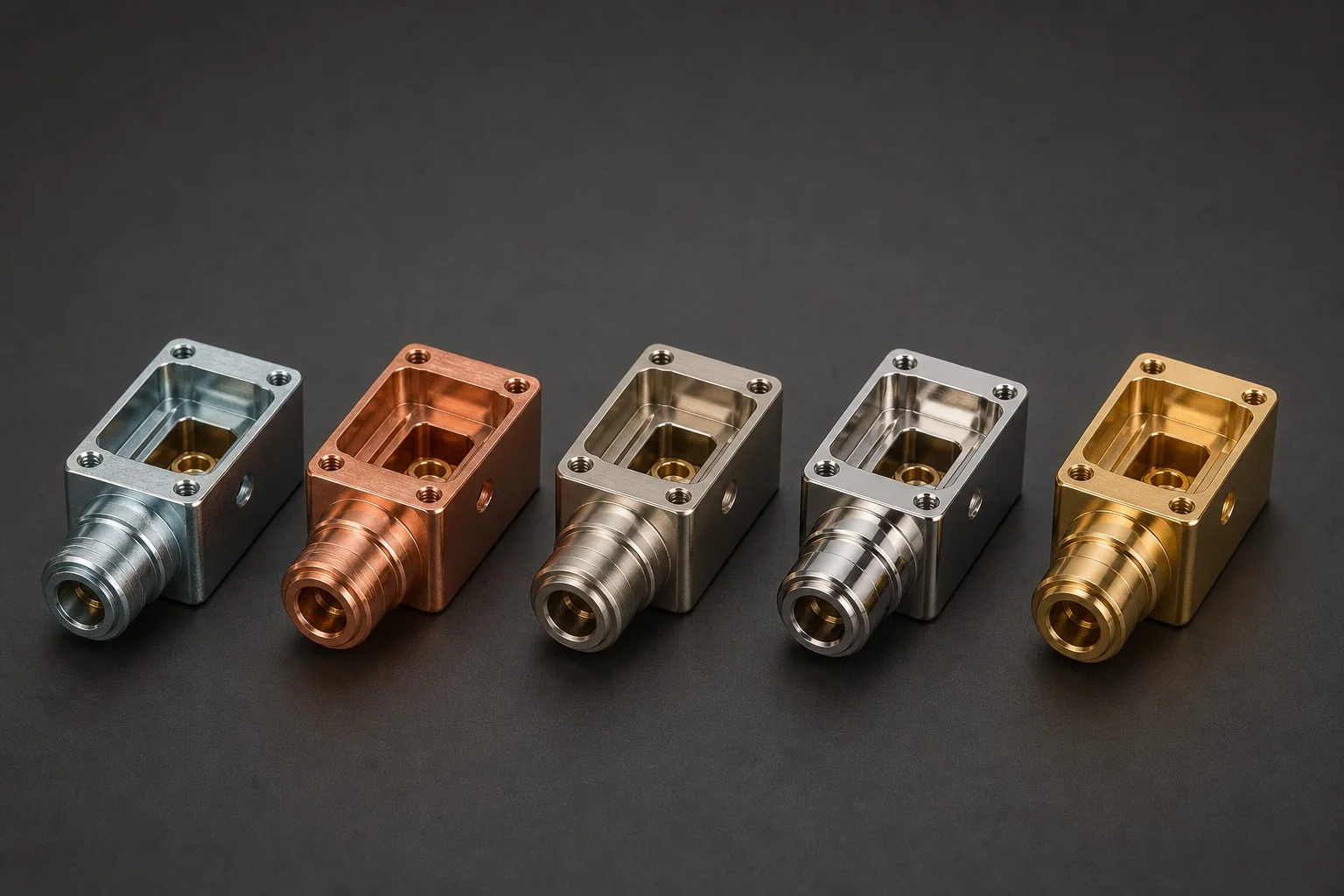
Color Does Not Identify the Complete Process
A silver finish may be zinc, nickel, tin, silver, chromium, or a multilayer system. A gold appearance may be a precious-metal contact finish or a colored supplementary treatment. The drawing should name the deposit, underplate, thickness, class, and post-treatment.
- Specify matte, satin, bright, or other visual requirements only after the functional stack.
- Identify cosmetic zones and acceptable rack, contact, and drainage marks.
- Use approved samples for highly reflective, dark, or color-sensitive finishes.
- Define storage and packaging for tarnish-sensitive or contact-critical deposits.

Thickness where it matters
Edges Plate Faster; Deep Recesses May Plate Slower
Electroplating thickness follows current-density distribution. Sharp edges and surfaces close to anodes can receive more deposit, while recesses, blind holes, and shielded regions may receive less. Auxiliary anodes, shields, robbers, part orientation, and rack design help manage the range.
Inspection may use X-ray fluorescence, magnetic methods, coulometric testing, or destructive microsection depending on deposit and substrate. Measurement locations and minimum local thickness should be defined on the drawing.
Process comparison
Electroplating or Another Metallic Finish?
The correct route depends on substrate conductivity, geometry, target properties, thickness uniformity, temperature, and acceptable dimensional change.
| Process | Deposition mechanism | Key design implication |
|---|---|---|
| Electroplating | External direct current reduces metal ions onto a conductive cathode. | Current density and geometry drive thickness distribution; rack contact is required. |
| Electroless nickel | Autocatalytic chemical reduction deposits nickel alloy without external current. | Often offers more uniform coverage on complex geometry; chemistry and phosphorus content change properties. |
| Conversion coating | Chemically transforms the substrate surface rather than depositing a separate bulk metal layer. | Usually thinner and substrate-specific; performance differs from a plated metal barrier. |
| PVD | Vacuum vapor deposition forms a thin metallic or ceramic film. | Line-of-sight coverage and vacuum compatibility matter; deposits are generally much thinner than engineering electroplate build-up. |
Before production
Six Details to Put on the Drawing
Substrate & Strength
State the exact alloy, heat treatment, hardness or tensile strength, and any high-strength-steel hydrogen-embrittlement restrictions.
Deposit Stack
Name every underplate and top layer, applicable specification, class, type, supplementary finish, and revision.
Thickness Locations
Define minimum and maximum thickness, significant surfaces, measurement points, and finished dimensional allowance.
Masking & Rack Areas
Mark threads, fits, contacts, grounds, bores, seal faces, and acceptable rack or electrical-contact locations.
Post-Treatment
Specify passivate, sealer, bake, heat treatment, polishing, anti-tarnish step, or lubrication and required timing.
Inspection & Compliance
State thickness, adhesion, porosity, corrosion, solderability, contact, appearance, sampling, and substance-reporting needs.
Controlled plating workflow
From Substrate Preparation to Protected Packing
- 01
Review & Prepare
Confirm substrate, strength, stack, thickness, masking, rack contact and tests; clean, descale, degrease and activate the surface.
- 02
Rack & Plate
Establish reliable electrical contact, orient the part, control current, chemistry, agitation, temperature, anodes, time, and deposit build.
- 03
Rinse & Post-Treat
Complete staged rinsing, passivation or sealing, drying, and hydrogen-embrittlement relief or other post-treatment when specified.
- 04
Inspect & Pack
Verify thickness, adhesion, dimensions, appearance and required performance before clean, non-marring, tarnish-aware packaging.
Project questions
Electroplating FAQ
Is electroplated nickel the same as electroless nickel?
No. Electroplated nickel uses external current and follows current-density distribution. Electroless nickel uses an autocatalytic chemical reaction and generally produces a more uniform deposit on complex geometry.
Can high-strength steel be electroplated?
Only after a specific risk review. Cleaning and plating can introduce hydrogen, which may cause delayed brittle failure. Material strength, stress condition, process route, pre- and post-bake requirements, and timing must follow the applicable specification.
Can plastic parts be electroplated?
Selected plastics such as plating-grade ABS can be metallized and then electroplated after specialized etching, activation, and conductive-layer preparation. This is a different pretreatment route from plating a metal part and requires design-specific validation.
Does salt-spray time predict exact service life?
No. Accelerated corrosion tests compare systems under defined laboratory conditions but do not directly convert to years in service. Real performance also depends on geometry, damage, environment, assembly, galvanic couples, and maintenance.
Ready to define the plating stack?
Send the Substrate, Drawing, and Performance Requirement
We will review deposit selection, underplate, thickness, masking, current distribution, hydrogen-embrittlement controls, inspection, and production quantity.
Start Your Project