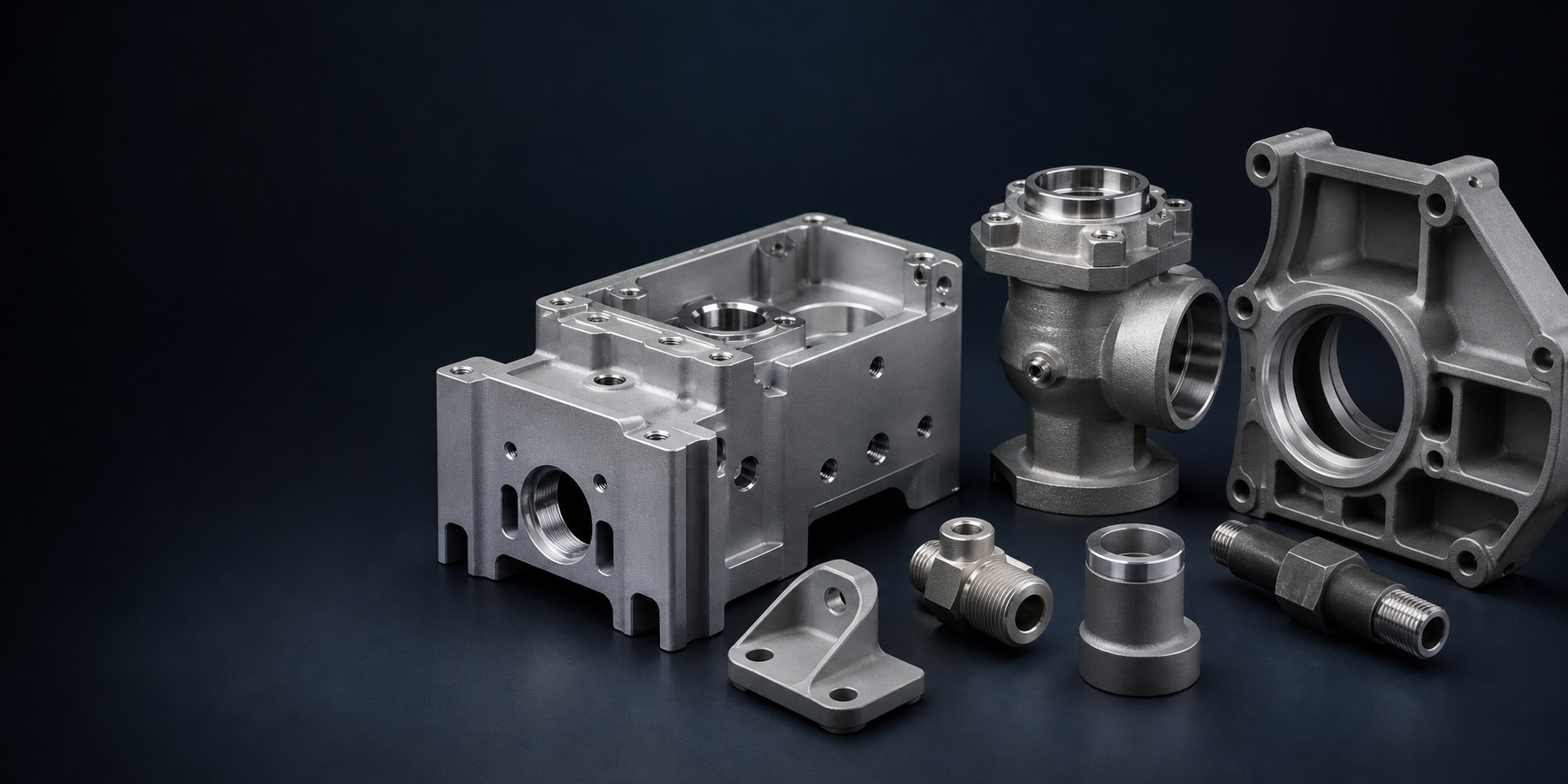
Qualified media can remove oxide, scale, light corrosion, residue, or old finish while preparing the substrate for the next operation.
Clean, texture, and prepare with controlled media
Abrasive Blasting
Air, wet, bead, and selected shot-blasting routes for non-directional appearance, surface cleaning, coating preparation, and controlled texture on precision components.
How abrasive blasting works
Accelerated Media Changes the Surface by Impact
Abrasive blasting propels selected particles with compressed air, water, or centrifugal equipment. Each impact can remove contamination, cut or peen the surface, reduce reflectivity, blend appearance, or create a profile for a subsequent coating.
“Sandblasting” is a common name, but industrial blasting is not limited to sand. Media composition, shape, size, hardness, pressure, nozzle, angle, stand-off distance, traverse speed, dwell, part rotation, cleanliness, and reuse condition all influence the result.
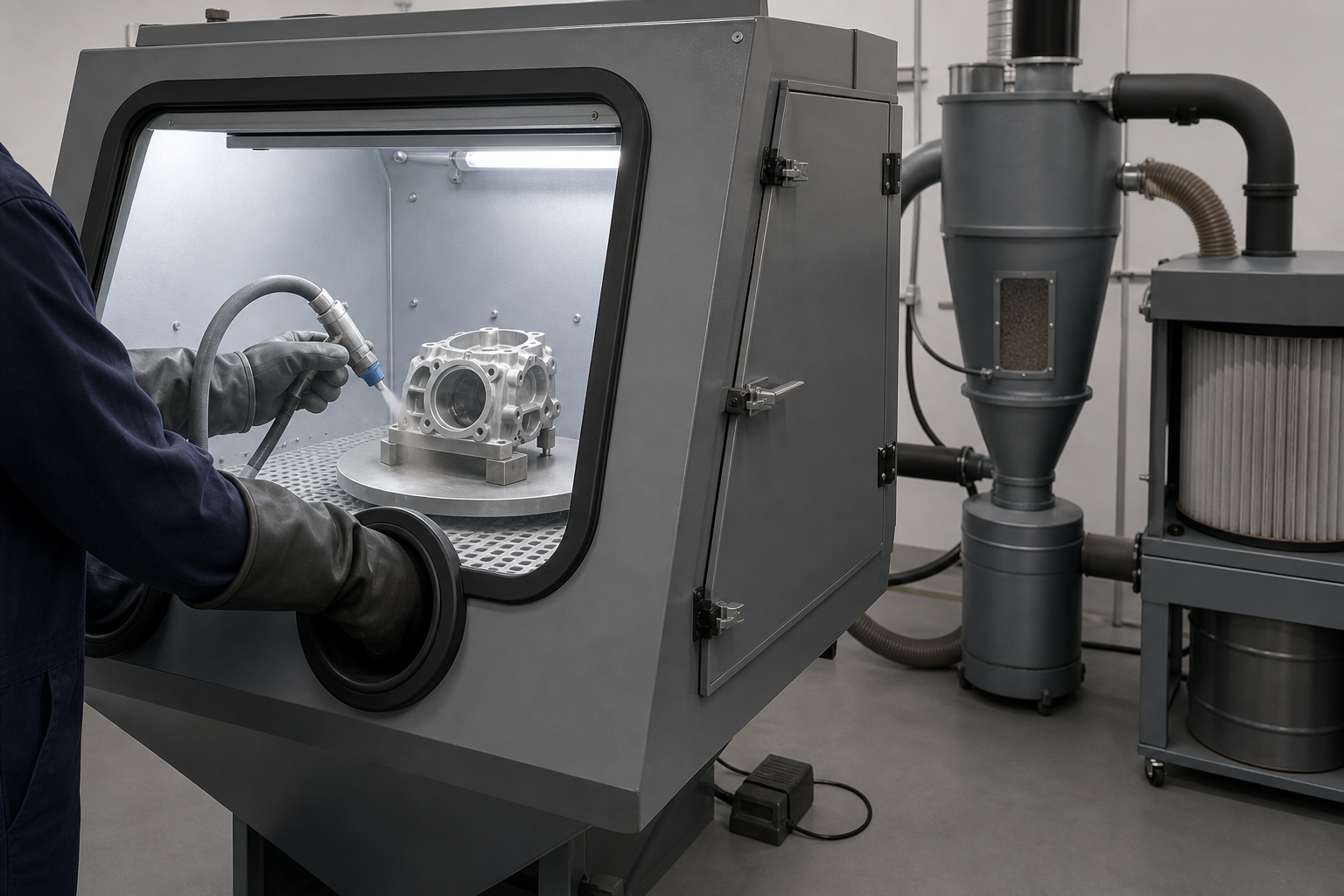
Angular media can create mechanical keying for paint, powder, or another validated coating when the profile matches the coating system.
Fine bead or ceramic media can create a low-reflective, generally non-directional cosmetic surface on suitable components.
A controlled nozzle or automated motion can reach contours and pockets that are difficult to finish with a flat abrasive belt.
Media selection
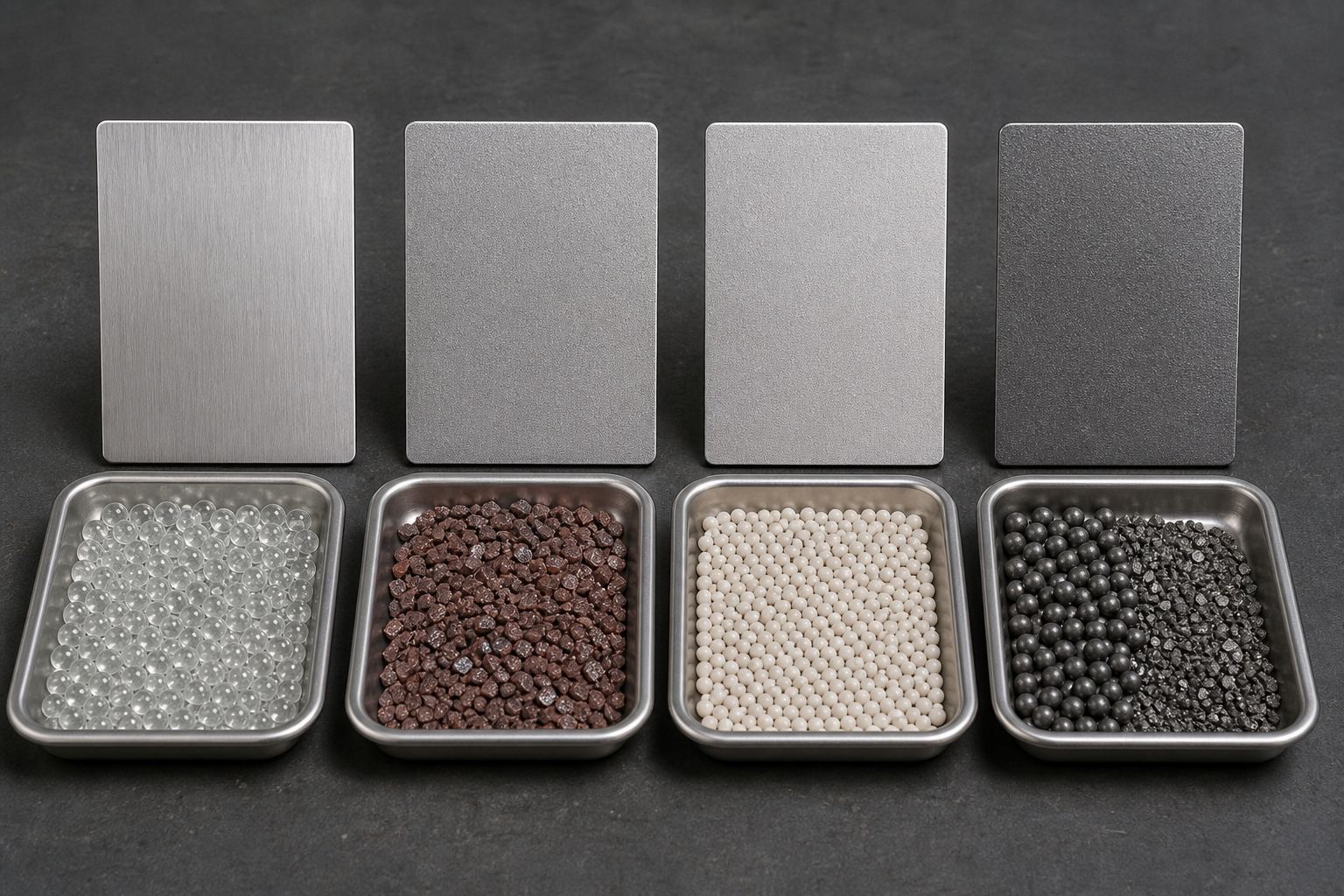
Particle Shape Changes How the Surface Is Cut or Peened
Media names and mesh numbers alone are not a complete specification. Source, size distribution, shape, hardness, cleanliness, breakdown rate, reuse limits, and the substrate must be reviewed together.
Glass Bead
Rounded beads tend to produce a fine satin, low-cut appearance and light peening action. Excess pressure or worn, contaminated media can change texture and embed residue.
Aluminum Oxide
Hard angular grit cuts aggressively for cleaning and profile generation. Grade and pressure must be balanced against dimensional edges, soft alloys, and the next coating.
Ceramic & Specialty Media
Ceramic bead, garnet, plastic, bicarbonate, organic, and other media serve different fine-finishing, cleaning, deburring, or substrate-sensitive applications.
Steel Shot & Grit
Round steel shot peens; angular steel grit cuts. They are used on suitable ferrous parts and in air or wheel-blast systems, but must not contaminate stainless or nonferrous cosmetic work.
Media and substrate compatibility
The Same Pressure Does Not Produce the Same Surface
Rounded and angular particles transfer energy differently. A media that gently satin-finishes stainless can be too aggressive for a thin aluminum wall; a fine cosmetic media may be too slow to remove scale or create the profile required by a heavy coating.
- Keep stainless and nonferrous media systems isolated from carbon-steel contamination.
- Match profile height to coating thickness so peaks receive adequate coverage.
- Control media breakdown, dust, fines, oil, moisture, and carryover between jobs.
- Qualify both appearance and dimensional effect on representative geometry.
Cleanliness and profile are separate
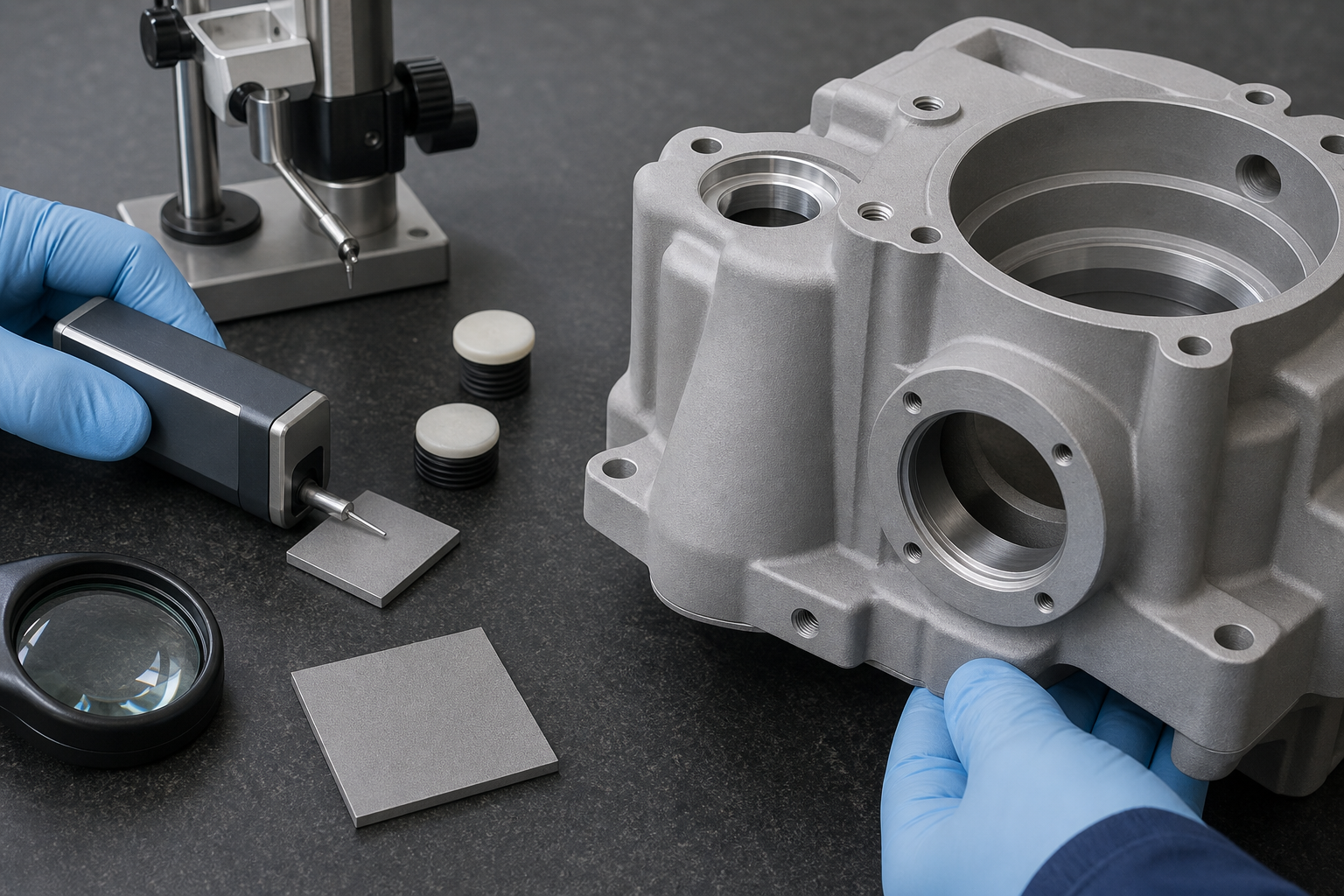
A Uniform Color Does Not Prove the Correct Surface
Visual inspection confirms coverage, color, stains, shadowing, embedded media, and handling marks. Roughness or profile may require a comparator, replica method, or contact/non-contact measurement selected for the part and specification.
Threads, sealing lands, bearing bores, identification marks, electrical contacts, sharp edges, and finished dimensions must also be checked after masking removal and final cleaning.
Process comparison
Air Blast, Wet Blast, Wheel Blast, or Shot Peening?
These terms describe different delivery systems and objectives. They should not be used interchangeably on a production drawing.
| Route | Typical purpose | Key implication |
|---|---|---|
| Air Abrasive Blast | Cleaning, cosmetic texture, deburring, or coating profile with a nozzle. | Pressure, nozzle motion, angle, distance, media, and coverage require control. |
| Wet / Vapor Blast | Media carried in water for fine cleaning and satin finishing with reduced airborne dust. | Slurry chemistry, rinsing, drying, corrosion control, and wastewater handling matter. |
| Wheel Blast | High-volume cleaning or descaling using a centrifugal wheel, often with metallic media. | Best suited to robust metal parts; fixture, flow, shadowing, and impact energy affect coverage. |
| Shot Peening | Controlled cold working to introduce compressive residual stress for fatigue performance. | Requires a dedicated peening specification, calibrated intensity, coverage, media, and process verification. |
Before production
Six Details to Put on the Drawing
Substrate & Condition
State the exact alloy, hardness, casting or machined condition, heat treatment, existing oxide or coating, and contamination to remove.
Purpose & Standard
Define whether the goal is cleaning, cosmetic texture, deburring, coating profile, wheel blasting, or qualified shot peening.
Media & Parameters
Specify approved media type, size or range, shape, cleanliness, delivery method, pressure window, and reuse restrictions where required.
Coverage & Masking
Mark blast zones and protect threads, bores, seals, fits, datums, labels, contacts, polished lands, and surfaces that must remain untouched.
Profile & Appearance
Define roughness or profile limits, measurement method and locations, cosmetic sample, gloss or color limits, and acceptable shadowing.
Next Process & Timing
State cleaning, passivation, anodizing, conversion coat, plating, painting, powder coating, corrosion protection, and maximum delay after blasting.
Controlled blasting workflow
From Process Qualification to Clean, Protected Parts
- 01
Review & Trial
Confirm substrate, objective, media, profile, cosmetic zones, masking, dimensions, safety controls, next finish, and an approved sample.
- 02
Clean, Mask & Fixture
Remove oil that could contaminate media, mask critical features, support thin walls, and orient the part to reduce shadowing and trapped abrasive.
- 03
Blast Under Control
Control media condition, pressure or wheel speed, nozzle, distance, angle, traverse, dwell, part rotation, coverage, ventilation, and dust collection.
- 04
Clean, Inspect & Finish
Remove residual media without recontamination, inspect appearance, profile and dimensions, then apply the specified downstream treatment within its process window.
Project questions
Abrasive Blasting FAQ
Is sand always used for sandblasting?
No. “Sandblasting” is commonly used as a general term, but glass bead, aluminum oxide, ceramic, garnet, plastic, organic media, steel shot, steel grit, and other materials are selected for specific substrates and objectives. Crystalline-silica hazards also make ordinary silica sand an unsuitable default.
Does blasting automatically improve coating adhesion?
No. It can improve mechanical keying only when the surface is sufficiently clean and the profile matches the coating system. Embedded contamination, excessive roughness, residual dust, moisture, or delayed coating can reduce performance.
Is shot blasting the same as shot peening?
No. Shot blasting commonly describes cleaning or texturing with shot, often in wheel equipment. Shot peening is a controlled fatigue-enhancement process requiring specified intensity, coverage, media, and verification; ordinary blasting should not be credited with that performance.
Can thin or precision parts be blasted?
Yes, after risk review. Impact can round edges, alter fits, erase markings, distort thin sections, change stress, or roughen sealing surfaces. Lower energy, fine media, wet blasting, support fixtures, masking, and representative trials may be required.
Ready to define the blast process?
Send the Substrate, Drawing, and Surface Requirement
We will review media, delivery method, profile, coverage, masking, contamination control, inspection, downstream finish, safety, and production quantity.
Start Your Project